Hispanovema presents its robotics approach to CBRN response at Hoyo de Manzanares
According to defensa.com, Hispanovema used an event at Hoyo de Manzanares on 5 November 2026 to show how it approaches CBRN response with drones and robots: supervised autonomy, interchangeable payloads and platforms that can coordinate with each other.
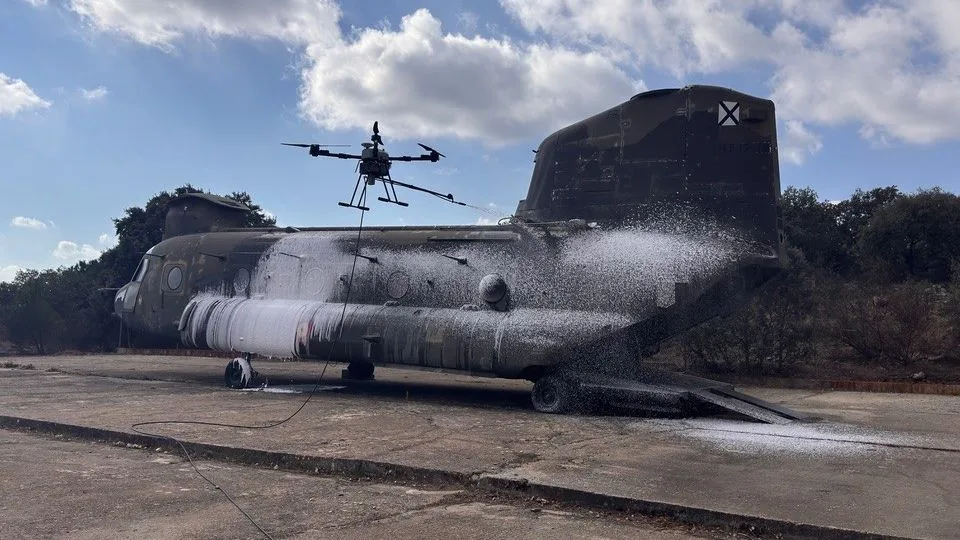
On 5 November 2026, Hispano Vema, S.L. (Hispanovema) brought together members of the Armed Forces, police forces and Civil Protection at Hoyo de Manzanares, Spain. There it explained how it combines robots, sensors, software and integrated platforms to respond to CBRN incidents. According to the defensa.com report, the event included two presentations, a static display of equipment and a demonstration of two systems, KIKA and LIBELULA.
Hispano Vema sitúa la robótica y la interoperabilidad en el centro de la respuesta NBQ (in Spanish)
defensa.com · José María Navarro García · 9 November 2026
Report on the Hispanovema event: CBRN threats, gaps in the current model and unmanned platforms that can be reconfigured for each mission.
What Hispanovema presented at the event
The talks were split into two presentations. The first reviewed what Hispanovema offers in drones and in the systems that go with them; AHCEBRIAN summarises this offer on the page about Hispanovema remotely operated platforms. The second was titled “Towards a new CBRN operational paradigm”. In it, according to the report, the company proposed moving away from a reactive response that requires people to enter the area physically, towards an integrated model organised around the mission. Both were given by José Antonio Navarro, CEO of Hispanovema, and Francisco Andrés Pérez, Director of Institutional Relations and Strategic Affairs.
Which CBRN threats and gaps Hispanovema pointed out
According to the report, Hispanovema started from the idea that an incident today can combine several agents, sources and types of event. Besides chemical and biological agents, there are incapacitating drugs, radioactive material and the contamination left by an accident, sabotage or damage to critical infrastructure. The report adds that drones and other commercial components can open the door to dispersed threats that are hard to predict and to attribute.
Against this background, defensa.com reports, the presentation listed six gaps in conventional models:
- Reconnaissance and sampling depend on people being present in areas that may be contaminated.
- It is hard to find out quickly which agent is involved, how far it extends and how long it persists.
- Information stays spread across teams and organisations.
- Access to complex spaces is limited.
- Assets have to be moved from one place to another quickly.
- Interoperability becomes difficult when several services take part, each with its own responsibilities.
The report sums up the approach this way: technology is not an end in itself, it is the means to close those gaps.
How autonomous are the robots Hispanovema showed?
According to defensa.com, one of the central points of the demonstrations was to show the operating modes of these systems, from remote operation to assisted navigation and supervised task execution, with the possibility of coordinating with other platforms. The same article explains that the systems can help plan and correct routes with what their sensors capture, while risk assessment and critical decisions stay with the personnel.
The machine can take on repetitive tasks or the most exposed ones, but reading the data and deciding the next step is still up to people: “human judgement remains decisive”, the report says. The systems presented also switch to a safe mode if there is interference, if the connection is weak or lost, or if a sensor fails.
Platforms that change modules according to the mission
According to the report, Hispanovema proposes leaving behind closed equipment designed for a single task. Each platform could carry different modules (chemical, biological or radiological detectors, sampling or intervention equipment). One set or another would be fitted depending on the site and the task: reconnaissance, detection, mapping, sampling, decontamination or verification.
If interfaces follow a standard and the software does not depend on the hardware, it would be easier to combine equipment from several manufacturers and to share the work between drones (UAV), ground vehicles (UGV), quadruped robots and surface vessels (USV).
The remotely operated platforms in the Hispanovema catalogue
The Hispanovema 2026 catalogue includes three unmanned platforms, which AHCEBRIAN describes on the page about Hispanovema remotely operated platforms:
- Four-legged ground UGV: it carries cameras, thermal imaging, CBRN detectors, a robotic arm, communications equipment or cargo on its back. It is operated remotely, within the coverage of the communications link.
- Aerial UAV: depending on the version, cameras and thermal imaging, CBRN sensors, spraying and agent release to support decontamination and firefighting, photogrammetry and LiDAR.
- Surface USV: a vessel with no crew on board for sea, rivers and ports, with cameras, radar, sonar, CBRN sensors, sampling equipment or rescue equipment.
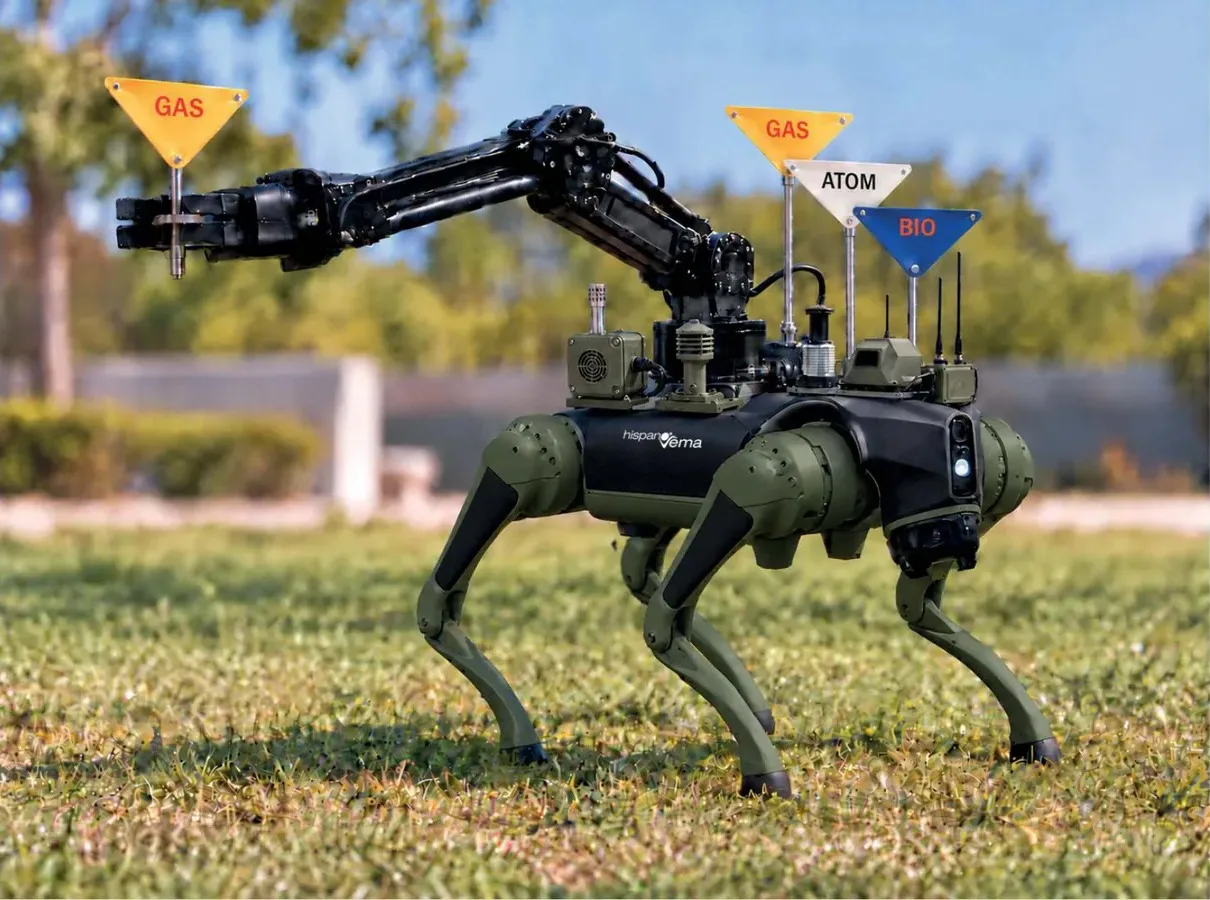
Image from the Hispanovema 2026 catalogue.
The catalogue does not publish endurance or payload capacity: they depend on the model and the equipment fitted, and the platform, payloads and data link are defined with the buyer. The manufacturer itself sets the limit when it compares the ground robot with the reconnaissance vehicle: the UGV does not replace the crewed vehicle, it complements it in local inspections.
Decontaminating sensitive equipment: a second defensa.com article
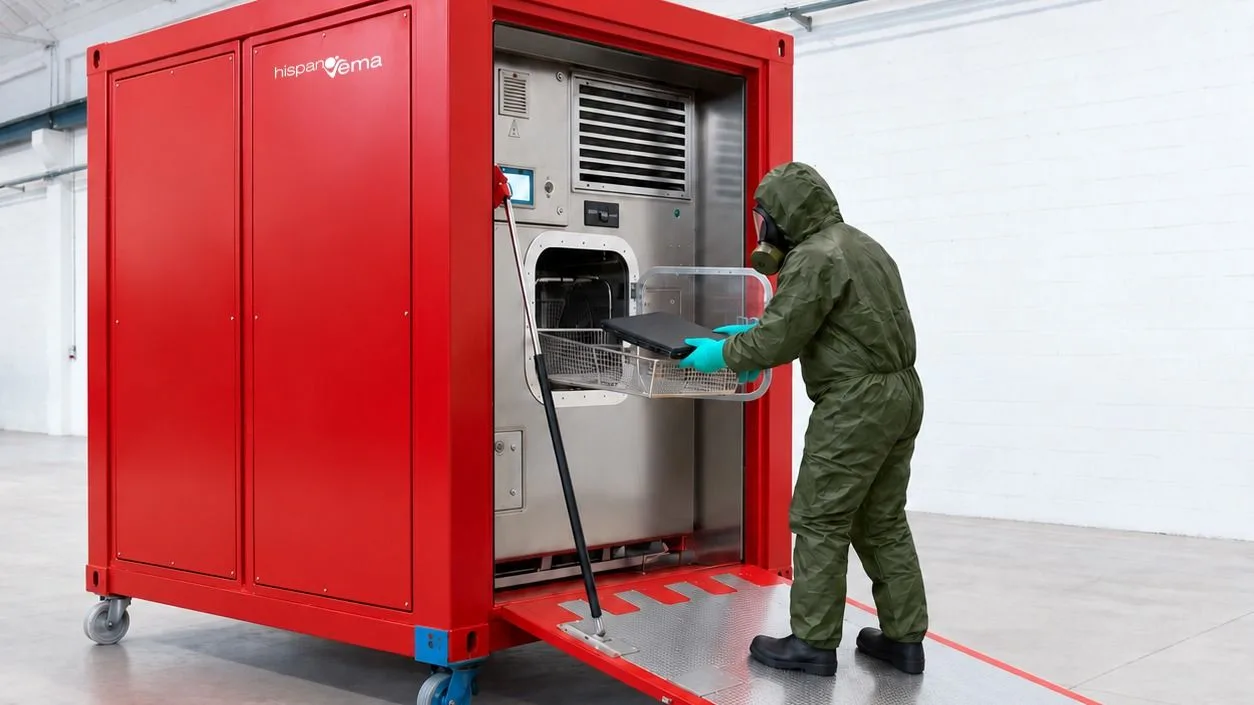
On 30 October, defensa.com announced that the CBRN Defence Military School (Escuela Militar de Defensa NBQ) at Hoyo de Manzanares would hold an event on decontamination in November, with theory and demonstrations. That article calls for a more “surgical” decontamination. The aim is to clean sensors, communications equipment, cameras, electronics and remotely operated platforms without damaging their components, with a procedure adapted to the agent and to each device.
La descontaminación NBQ, amenazas que no pueden ignorarse (in Spanish)
defensa.com · José María Navarro · 30 October 2026
Announcement of a CBRN Defence Military School event on decontamination, with special attention to electronics and remotely operated equipment.
In the Hispanovema catalogue, the eDECON 10 case is designed for sensitive equipment: the RD50 agent is applied as a spray and then removed by vacuuming.
If you would like technical information on these platforms, AHCEBRIAN S.L., which represents Hispanovema commercially, can provide it: you can write to us from the contact page.