Egg-derived ingredients: EU allergen labelling and the supplier allergen declaration you need
Eggshell membrane and eggshell powder are declared as egg, emphasised in the list of ingredients. “May contain” is voluntary: to decide on it, you need the supplier allergen declaration and a cross-contact declaration.
Eggshell membrane and eggshell powder fall under “Eggs and products thereof” in Annex II of Regulation (EU) No 1169/2011. If you use them as ingredients, egg must be declared and emphasised in the list of ingredients of your product, “even if in an altered form”. A “may contain egg” statement is different: it is voluntary and depends on cross-contact. To handle both, you need the supplier to give you, in writing, the composition, the supplier allergen declaration and its allergen management policy.
In short
- Egg has no exemptions in Annex II, unlike milk, soy or fish. Eggshell membrane and eggshell powder are declared as egg.
- In the EU, egg is emphasised inside the list of ingredients. A separate “allergen warning” box, common on labels made outside the EU, does not replace it.
- Your supplier must give you sufficient information (Article 8(8)). A composition statement is not enough to decide on a “may contain” statement: also ask for a cross-contact declaration for the plant and the line.
Are eggshell membrane and eggshell powder declared as allergens?
Yes. Point 3 of Annex II of Regulation (EU) No 1169/2011 reads “Eggs and products thereof”. Article 9(1)(c) makes it mandatory to indicate any ingredient listed in Annex II, or derived from a product listed there, that is used in the food. The rule applies while the ingredient is “still present in the finished product, even if in an altered form”. Eggshell membrane and eggshell powder come from hen’s eggs (Gallus gallus). Drying or milling them does not take them out of this category.
Some Annex II groups have written exemptions: wheat based glucose syrups, fish gelatine used as carrier for vitamin or carotenoid preparations, fully refined soybean oil and fat, or lactitol. Egg has none. The Commission Notice 2017/C 428/01 confirms this in point 6: Annex II covers “not only substances and products mentioned as such therein but also products thereof”, and “egg” refers to “eggs from all farmed birds”.
The Commission applied this rule in 2026. Implementing Regulation (EU) 2026/1427 of 2 July 2026 authorises an egg membrane hydrolysate (enzymatically produced) as a novel food for food supplements. Its recital 13 states that, because the source is egg, these supplements “should be appropriately labelled following the requirements of Article 21”. This hydrolysate is not one of Egglin’s eggshell membrane and eggshell ingredients. Egglin supplies native eggshell membrane powder. The example shows how the rule is applied; it says nothing about Egglin’s product.
This article covers foods and food supplements. Cosmetics, another use of these ingredients, have their own rules and are outside its scope.
How is egg shown on the label of the final product in the EU?
Inside the list of ingredients, and emphasised. Article 21(1) requires a clear reference to the name in Annex II, emphasised “through a typeset that clearly distinguishes it from the rest of the list of ingredients, for example by means of the font, style or background colour”. It is enough to emphasise the part of the ingredient name that corresponds to the allergen (Commission Notice 2017/C 428/01, point 16). For example: “eggshell membrane powder” or “eggshell powder”.
There are two special cases. If the product has no list of ingredients, the label uses the word “contains” followed by “egg” (Article 21(1), second subparagraph). If the name of the food already refers to egg and the pack has a list of ingredients, egg is still emphasised in that list (Commission Notice 2017/C 428/01, point 25).
Labels made for other markets need a review. The box of eggshell powder sticks that Egglin sells in Turkey has a separate block, with an icon, titled “Alerjen uyarısı / Allergen warning”. Its text reads “Yumurta kabuğu içerir. Includes egg shell”. This is the format the manufacturer uses for its own market (a finished product of the manufacturer, not on sale in Spain).
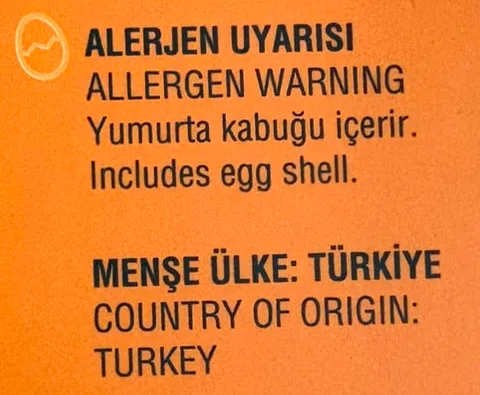
Allergen block on Egglin’s eggshell powder box for the Turkish market (manufacturer’s photo, 22 August 2026).
In the EU, that block does not replace the emphasis inside the list. Point 27 of Commission Notice 2017/C 428/01 also says that “it is not possible to voluntarily repeat the allergen information outside the list of ingredients”, whether with the word “contains” or with “symbols or text boxes”. If you plan to sell eggshell membrane or eggshell supplements under your own brand, the label must be redone: egg emphasised in the list and no extra box.
What must the supplier allergen declaration and documentation include?
Enough for you to comply, and the core document is the supplier allergen declaration. Article 8(8) of Regulation (EU) No 1169/2011 states that operators who supply other operators with “food not intended for the final consumer or to mass caterers shall ensure that those other food business operators are provided with sufficient information” to meet their own obligations. This is the legal basis for business-to-business documentation: technical data sheet, allergen declaration and anything else your specification requires.
The regulation does not list documents. You define what “sufficient” means in your purchase specification, supply contract or supplier allergen questionnaire. Our recommendation: put it in writing before the first order, per product and per particle size, with a version number and a date.
Responsibility for the label does not move to the supplier. Under Article 8(1), the responsible operator is the one under whose name the food is marketed or, if that operator is not established in the EU, the importer. When the ingredient comes from Turkey, the European company that imports it or puts its brand on the product is responsible. The supplier’s documents are the basis of your label. They do not transfer that responsibility.
When should you add “may contain egg”?
Only when your risk assessment justifies it. A statement on the possible and unintentional presence of an allergen is voluntary information. Article 36(2) requires that it does not mislead, is not ambiguous or confusing, and is, where appropriate, “based on the relevant scientific data”. Article 36(3)(a) asks the Commission to adopt implementing acts for this statement. Until they are published, these general requirements apply.
That EU act may be delayed. According to Allergen Bureau (4 September 2026), the Commission has asked the European Food Safety Authority (EFSA) to assess the FAO/WHO reference doses, with a deadline of 31 July 2028. For this reason, Allergen Bureau considers it unlikely that the implementing act on precautionary allergen labelling in the EU will arrive in the fourth quarter of 2027, as announced.
The most recent international reference comes from the Codex Alimentarius. On 6 July 2026, the Codex Alimentarius Commission adopted guidelines on precautionary allergen labelling. According to the FAO press release, the decision must be based on a risk assessment. The statement is used only when, after suitable mitigation measures, the unintended presence exceeds an action level. The stated aim is to avoid unnecessary use. The Codex guidelines are not EU law, but their reference doses are the ones the Commission has asked EFSA to assess for the EU.
Cross-contact: towards your product and towards your range
Cross-contact is the unintended presence of an allergen because a plant, line, tools or storage area are shared. With an egg ingredient, it works in two directions:
- Towards your product. Can the ingredient bring other allergens from the supplier’s plant? The composition statement does not answer this. The supplier’s cross-contact declaration for the plant and the line does.
- Towards the rest of your range. When you bring eggshell membrane or eggshell powder into your plant, egg becomes an allergen present on your site. Your egg-free products that share a line, tools or storage need a new assessment. Regulation (EU) 2021/382 amended Annex II of Regulation (EC) No 852/2004. Since then, equipment, conveyances and containers used for an Annex II allergen “shall not be used” for food without it, “unless the equipment, conveyances and/or containers have been cleaned and checked at least for the absence of any visible debris of that substance or product”.
Our position: do not copy the supplier’s “may contain” statement and do not add one by default. A statement without an assessment behind it is not based on scientific data, as Article 36(2) requires. It is also exactly the use that the Codex guidelines want to avoid.
What does Egglin’s allergen documentation say, and what is missing?
The technical data sheets for Egglin eggshell membrane (version 01.04, Bandırma, 10 August 2026; batch EGGM3002604 at 90-110 µm and batch EGGM3002605 at 200-250 µm) give the ingredient as “Chicken (Gallus gallus) Egg Shell Membrane”. Their allergen statement starts with “Egg Product” and then lists what the product does not contain: dairy, starch, sugar, wheat, gluten, soy, corn, fish, shellfish, salt, tree nuts or GMOs. “Shellfish” is also ambiguous: ask the supplier to state crustaceans and molluscs separately.
This gives you what you need for the mandatory declaration: the ingredient is egg and must be emphasised. There are two limits. It is a composition statement, so it does not say whether other allergens are handled in the plant or on the line. And its negative list does not cover all 14 groups of Annex II: it does not name peanuts, sesame, celery, mustard, lupin or sulphites.
How cross-contact is managed is described in Egglin’s allergen management policy RC-01 (revision 02, 7 March 2026), available on request. It provides for dedicated areas and tools, cleaning validation with a rapid ATP test, and mandatory staff training with a refresher every two years. At goods intake, eggshell and egg residues are treated as allergenic material, and each container is identified as such. The policy requires Egglin’s raw material and packaging suppliers to declare the allergens present at their sites, and records are kept for at least 5 years. The full document is not published because it includes the internal layout of the lines. It does not replace a declaration of which allergens are handled in the plant and on the line: ask for that separately.
The product pages for natural calcium and eggshell powder give the ingredient, “Chicken (Gallus gallus) eggshell”, but do not include a written allergen declaration. Do not assume the membrane declaration applies to them: ask for a written declaration for each ingredient.
Document | Eggshell membrane technical data sheets | RC-01 policy | Natural calcium and eggshell powder product pages |
|---|---|---|---|
What it declares | Ingredient (Gallus gallus), “Egg Product” and a list of what it does not contain | How allergens are managed in the plant: areas, tools, cleaning, training, records | Ingredient (Gallus gallus) |
What it does not cover | Cross-contact; 6 of the 14 Annex II groups | It is not a declaration per product or per batch | Written allergen declaration |
Version or date | 01.04, 10 August 2026, batches EGGM3002604 and EGGM3002605 | Revision 02, 7 March 2026 | Web product page, August 2026 |
Access | With the technical documentation | On request | Public page; declaration on request |
If you plan to formulate with these ingredients, ask us for the technical data sheet with the allergen declaration and Egglin’s RC-01 policy. We will also send you the certificate of analysis of the batch.
What to do now: documents to request from your supplier
- Specification with ingredient name and species: the exact name and species (Gallus gallus), as you will copy it into your list of ingredients.
- Signed and dated supplier allergen declaration, per product and per particle size, covering all 14 Annex II groups.
- Cross-contact declaration: allergens handled in the same plant and on the same line.
- Summary of the allergen management policy, with version number and date.
- Method and frequency of cleaning validation: the absence of visible debris is the minimum set by Regulation (EU) 2021/382. Ask whether, in addition to the rapid ATP test, it includes a specific test for egg protein.
- Certificate of analysis for the batch you receive.
- Written commitment to notify you of any change of recipe, line or plant.
With these documents, your quality team can complete the mandatory declaration and decide, as a separate step, whether your risk assessment justifies a “may contain” statement.