Personnel corridors and positions
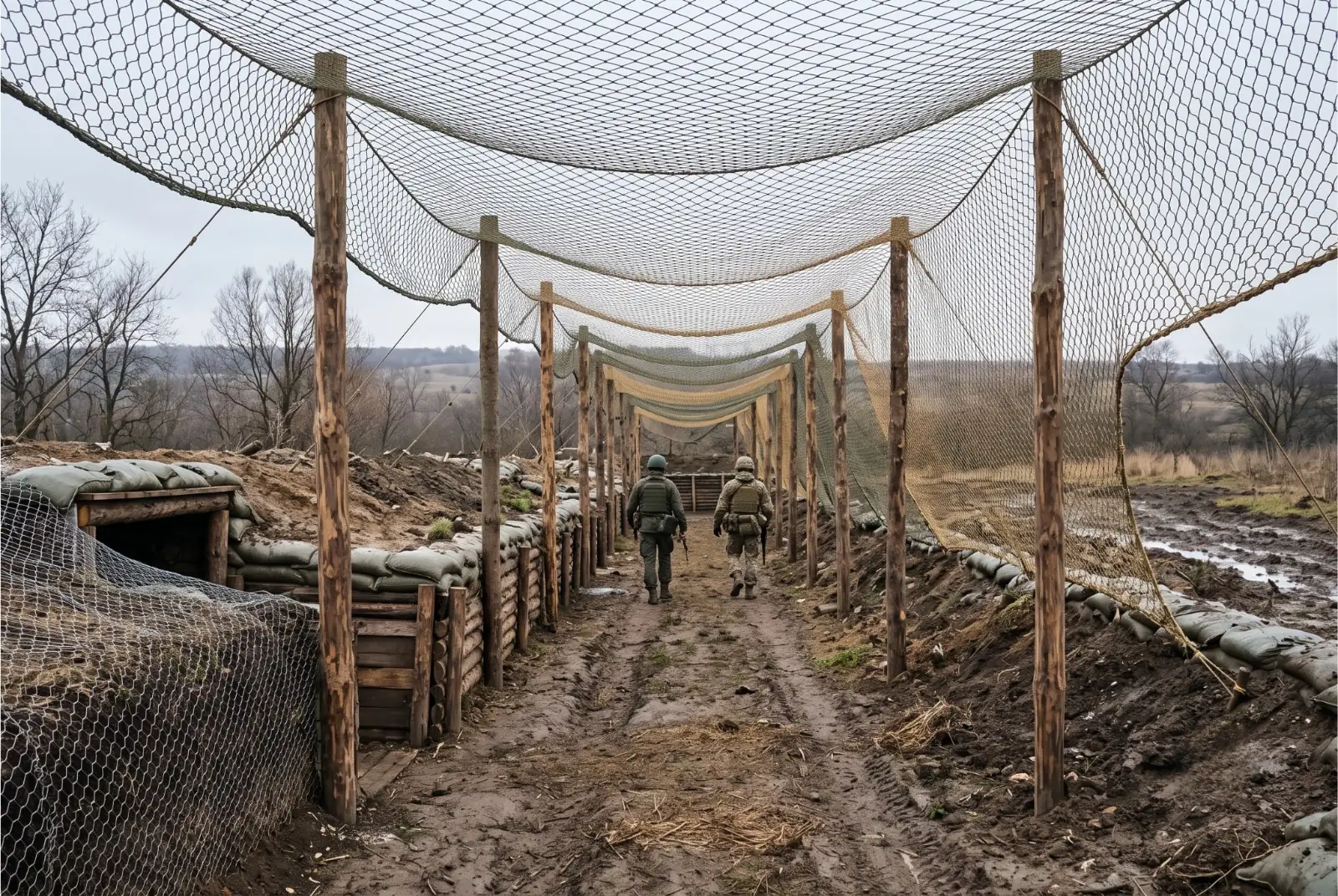
Continuous canopy over trenches, access routes and relief points. Khaki and tan add visual concealment to the same panel, with no extra material.

High-tenacity polyamide physical barriers to cover personnel, critical infrastructure and perimeters against FPV drones. Own manufacturing in Turkey, 17 references in production and more than four years of continuous supply to active conflict zones in Eastern Europe.
The FPV drone has inverted the economics of protection: cheap, mass-produced and able to reach what nothing reached before. Against it, the net does not compete on technology. It competes on physics.
The attack arrives vertically or in a dive, along the axis that neither side armour nor a perimeter wall covers. An overhead canopy is the only barrier that cuts that trajectory.
Low flight, small signature and a terrain-hugging approach. Detection comes late or not at all, and the reaction window is measured in seconds.
Fibre-optic links and autonomous navigation render electronic warfare ineffective. The net does not care which frequency the aircraft uses, because it uses none.
Three things, and none of them needs power.
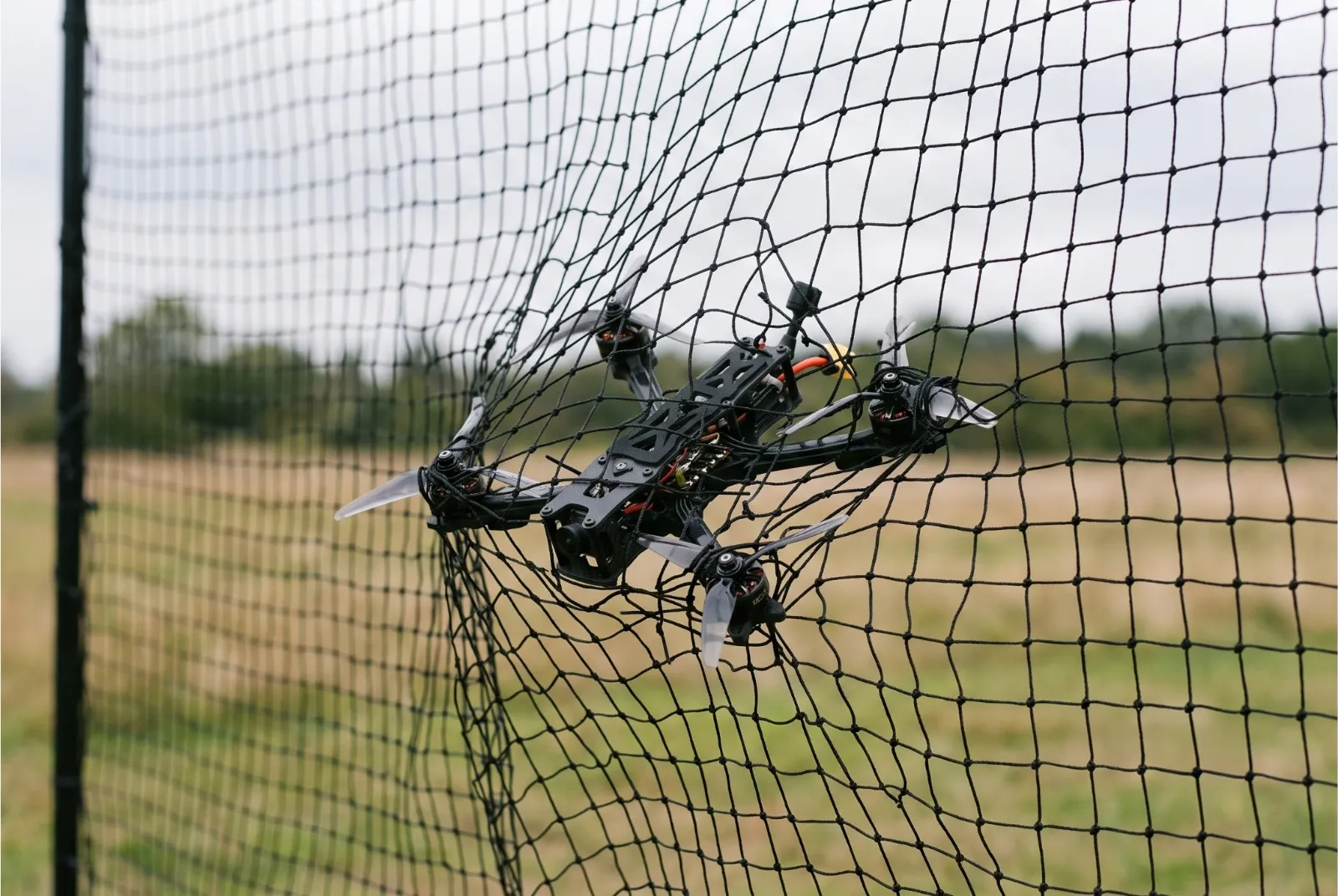
The mesh absorbs the impact energy and tangles propellers and landing gear. The aircraft loses lift and falls away from the target.
No radio frequency, no power consumption and no detectable signature. It needs no spectrum licence and does not interfere with your own communications.
200 m panels over wooden posts, tensioning cable or light structure. Modular assembly, field-repairable and replaceable section by section.
The net is a physical protection layer: it complements detection and electronic countermeasures, it does not replace them.
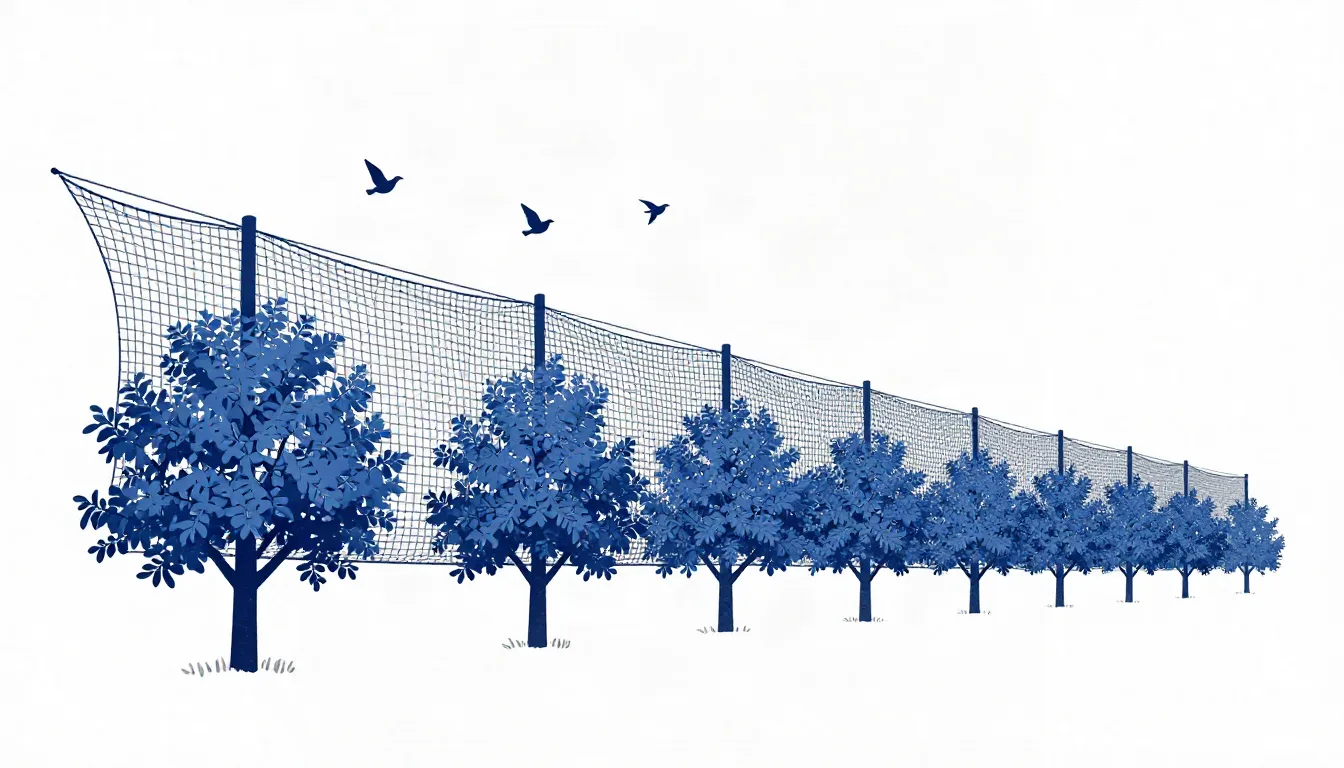
The three deployments we are asked for most.

Continuous canopy over trenches, access routes and relief points. Khaki and tan add visual concealment to the same panel, with no extra material.

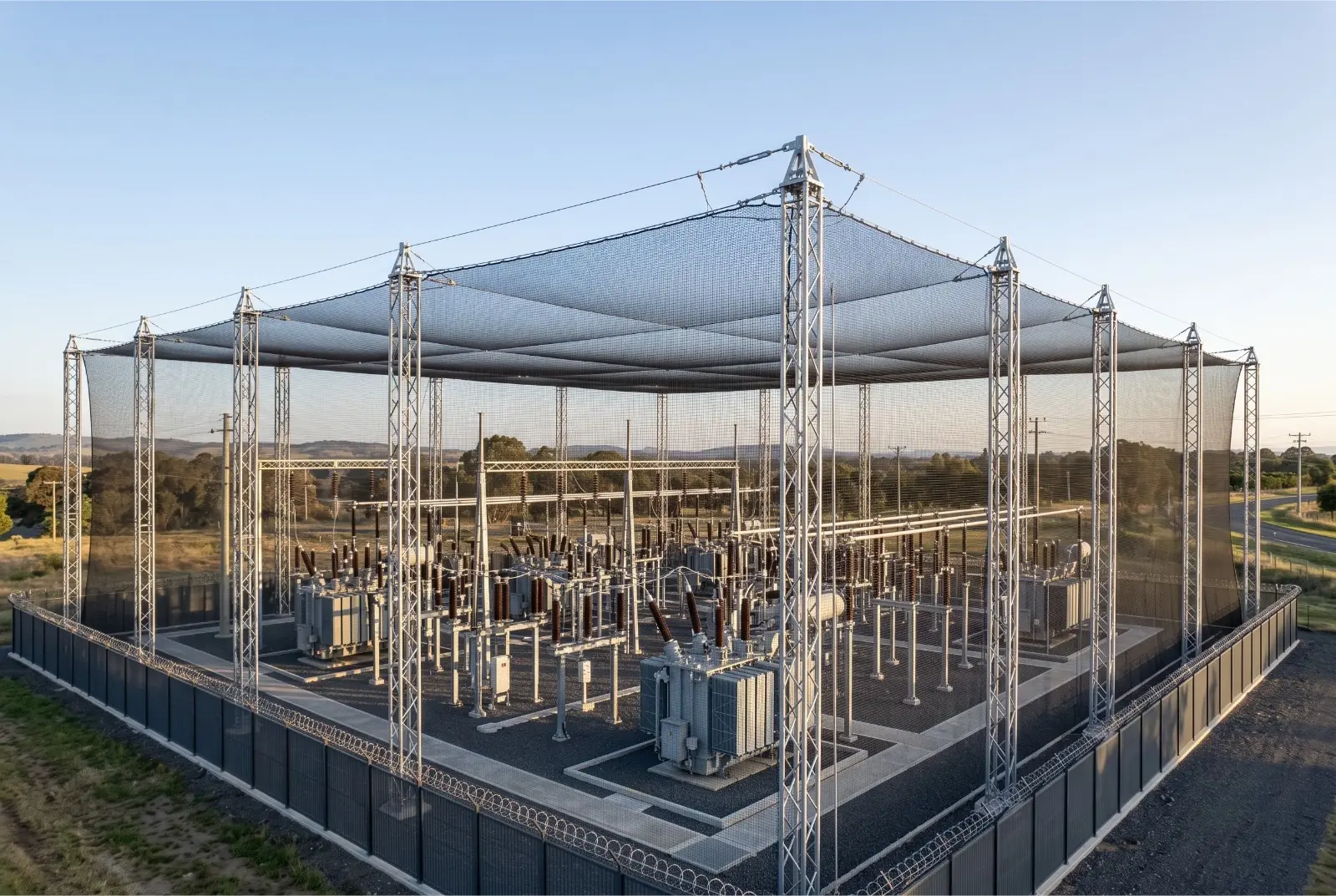
Cages over electrical substations, fuel depots, antennas and radars. Fixed installation on towers and carrying cables, with no heavy works and no service interruption.

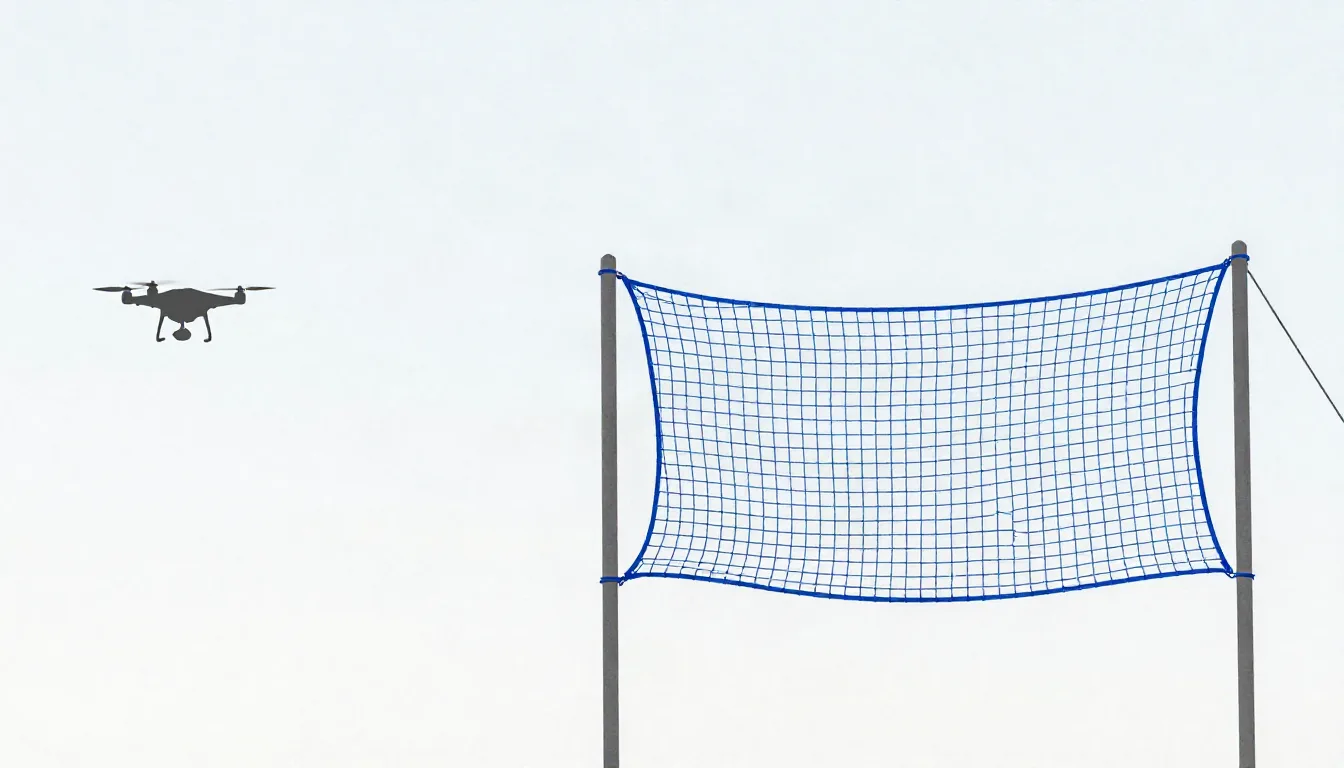
Vertical curtains on posts to close low-level approaches at bases, vehicle parks and warehouses. Combined with an overhead canopy, they close the full volume.
All in knotted polyamide (Nylon 6), in panels of 200 metres stretched length. Mesh size is chosen by the size of the threat; twine title, by load and expected service life.
Filter by mesh size
| Reference | Twine | Mesh size | Depth | Approx. drop |
|---|---|---|---|---|
| 6-20-100 | 210/6 | 20 mm | 100 meshes | ≈ 2,00 m |
| 9-20-100 | 210/9 | 20 mm | 100 meshes | ≈ 2,00 m |
| 6-45-50 | 210/6 | 45 mm | 50 meshes | ≈ 2,25 m |
| 6-45-100 | 210/6 | 45 mm | 100 meshes | ≈ 4,50 m |
| 9-45-50 | 210/9 | 45 mm | 50 meshes | ≈ 2,25 m |
| 9-45-100 | 210/9 | 45 mm | 100 meshes | ≈ 4,50 m |
| 12-45-100 | 210/12 | 45 mm | 100 meshes | ≈ 4,50 m |
| 9-70-26 | 210/9 | 70 mm | 26 meshes | ≈ 1,82 m |
| 9-70-64 | 210/9 | 70 mm | 64 meshes | ≈ 4,48 m |
| 12-70-100 | 210/12 | 70 mm | 100 meshes | ≈ 7,00 m |
| 12-100-45 | 210/12 | 100 mm | 45 meshes | ≈ 4,50 m |
| 21-100-45 | 210/21 | 100 mm | 45 meshes | ≈ 4,50 m |
| 12-150-29 | 210/12 | 150 mm | 29 meshes | ≈ 4,35 m |
| 9-200-27 | 210/9 | 200 mm | 27 meshes | ≈ 5,40 m |
| 9-200-34 | 210/9 | 200 mm | 34 meshes | ≈ 6,80 m |
| 6-300-27 | 210/6 | 300 mm | 27 meshes | ≈ 8,10 m |
| 9-300-27 | 210/9 | 300 mm | 27 meshes | ≈ 8,10 m |
17 of 17 references · 20 – 300 mm
9-70-64 → 210/9 twine (9 plies of 210 denier) · 70 mm mesh · 64 meshes deep. Length is always 200 m stretched.
Approximate drop is calculated as mesh size × number of meshes, with the panel stretched. It is an indicative figure: the real installation depends on tension and hardware.
We have been asked for the same range in high-modulus polyethylene and we are working on its production. At equal strength it allows a thinner twine, less weight and less wind load on the structure. Ask us about availability and lead times.
It does not replace detection or jamming: it covers what they do not.
It emits no radio frequency, so it falls outside the legal regime governing jammers and does not interfere with your own communications.
No battery to run flat, no system to switch off and no operator who has to stay awake. Once installed, it protects on its own.
A drone flown on a fibre-optic link or navigating autonomously ignores electronic warfare. A physical barrier does not care how the aircraft is guided.
Own manufacturing, no electronics and no scheduled maintenance. Damage is repaired section by section instead of replacing the whole system.
What buyers ask us before placing an order
It depends on the size of the aircraft you are protecting against. As a guide: 20–45 mm for small FPV drones, 70–100 mm for larger multirotors and light fixed-wing, and 150–300 mm to cover large areas or as an outer camouflage layer. Before an order is confirmed we review the specific scenario and the mounting structure with you.
The entire current range is knotted polyamide (Nylon 6), in panels of 200 metres stretched length, available in white, khaki and tan depending on the season. We have been asked for the same range in HMPE (high-modulus polyethylene) and we are working on its production: ask us about availability and lead times.
The usual assembly is on wooden posts or a light structure with a tensioning cable, forming an overhead canopy, a vertical curtain or a full cage. Panels overlap and are laced together, so a damaged section can be replaced without dismantling the rest. We do not supply installation: we deliver the panel and the technical support to size it.
3 to 4 weeks in total: 2-3 weeks of manufacturing at our Yozgat facilities plus 5-7 days of land transit to Iberia. We ship to Europe weekly. For large or recurring orders we can plan production in advance.
No. It is a physical protection layer that acts once the aircraft is already overhead, which is exactly why it also works against fibre-optic and autonomous drones that are immune to electronic warfare. The normal approach is to combine it with detection and countermeasures, not to choose between them.
Tell us the area, the type of structure and the threat you expect. We come back with reference, quantity and lead time.
Request a quote