Knotted bird netting: when a fishing net makes sense in orchards, vineyards and olive groves
A knotted fishing net fits permanent bird covers and enclosures in orchards and vineyards. We do not recommend it for hail netting, where Spanish crop insurance requires a 7 mm mesh at most and the market uses knitted netting, or as an olive harvesting net.
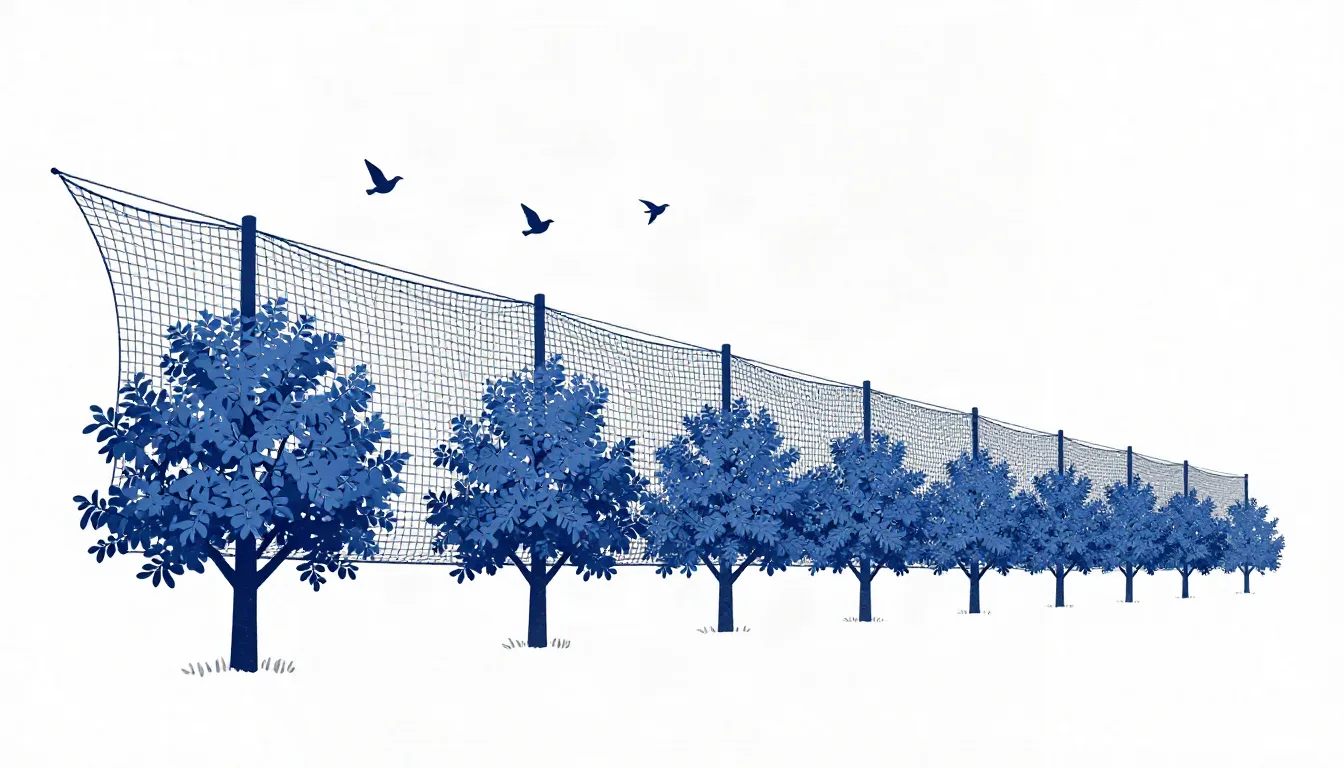
A knotted fishing net makes sense in agriculture when it will stay tensioned on a structure for years. As knotted bird netting for fruit trees and vines, it fits permanent covers and enclosures. We do not recommend it as hail netting: Spanish crop insurance for persimmon requires a mesh of 7 mm at most. At that size, the knot multiplies weight and cost compared with knitted netting. It does not replace an olive harvesting net either. This guide explains what to ask the factory, using the Tunanets catalogue.
In short
- Tunanets knotted netting fits permanent bird covers tensioned on cable. The double knot fixes the mesh, and panels reach 100 m in HDPE and 200 m in polyamide.
- We do not recommend it for hail netting, where the market uses knitted netting. We also do not recommend it as an olive harvesting net or to cover a single tree for one season.
- When you order, put in writing the mesh size and how it is measured, the twine, the colour, the stretch direction, and the ISO 1806, ISO 1805 and ISO 4892-2 tests.
Where does knotted netting fit on the farm? In permanent bird covers, not in hail netting
Tunanets, the Turkish manufacturer that AHCEBRIAN distributes in Europe, makes knotted polyethylene (HDPE) netting and knotted nylon (polyamide) netting at its plant in Yozgat. Its mesh range is 10 to 300 mm (Tunanets yarn catalogue).
Use | Knotted netting | Knitted (raschel) or monofilament netting | Reason |
|---|---|---|---|
Permanent bird cover on cables (orchard, vineyard) | Yes | Yes | Long panels, mesh fixed by the knot, repair with a netting needle |
Side enclosure or fruit cage | Yes | Yes | Knotted fruit cages are sold in the United Kingdom (product sheets) |
Insurable hail netting | We do not recommend it | Yes | Spanish persimmon insurance requires a mesh of 7 mm at most; at that size the knot multiplies weight and cost |
Olive harvesting net | No: it is a different product | Yes, polyethylene or polypropylene monofilament | It works on the ground, not under tension; Italian standard UNI 10407:1995 |
Cover for a single tree or a single season | We do not recommend it | Yes | More weight and cost, with no structure or years of use to justify them |
The Spanish crop-insurance order for persimmon farms (Orden APA/1/2026) sets a condition for insuring the structure: “the mesh grid” must have “a maximum opening of 7 mm” (our translation). The published Tunanets range starts at 10 mm. Even if the mesh could be made smaller, at that size a knotted net multiplies knots, weight and cost. The market uses knitted netting: product sheets for combined bird and hail netting describe 7 × 5 or 10 × 3 mm. That is why we do not recommend knotted netting for hail. Check the insurance rules for your crop and your country.
What does knotted bird netting add to a permanent cover? A mesh that does not slip
On a cover tensioned over cables, wind and the weight of the net pull on it for years. In Tunanets knotted nets, the double knot prevents mesh movement under tension (manufacturer's sheet). The mesh size you chose for the target bird therefore stays the same.
- Long panels. Up to 100 m in HDPE and 200 m in polyamide, with custom depth (Tunanets yarn dossier). This means fewer seams per row.
- Repair. A broken knotted mesh can be mended with a netting needle and the same twine.
The knot has drawbacks. In general, it adds twine and weight per square metre compared with a knitted net of similar mesh. The Tunanets dossier also lists price as a disadvantage. We do not have the weight per square metre for each reference: ask for it to size posts, cables and tensioners.
Our position: for a fixed cover used over several seasons, knotted bird netting is worth comparing. For protection that you put up and take down by hand every year, we recommend knitted netting, which is lighter and easier to fold.
Which mesh size for each bird? The largest one that keeps it out
We have not found a European (EN) or Spanish (UNE) standard that sets the mesh size of bird netting. What exists is market practice, in product sheets from Spain and the United Kingdom. They give 18 to 25 mm for small birds in orchards and vineyards, 28 mm for starlings and 50 mm for pigeons, with no tests cited. With the same twine, a smaller mesh needs more knots and weighs more. We recommend the largest mesh that keeps out the bird that causes the damage.
Also agree how the mesh is measured. Bird netting sheets usually give the side of the square. In fishing, the stretched mesh is also used: from one knot to the opposite knot, which is twice as long (ISO 16663 separates mesh opening and mesh length). The Tunanets sheet gives its 10 to 300 mm range without saying if it is the side of the square or the stretched mesh, so ask. In the order, write “side of the square, knot centre to knot centre”.
In vineyards, Tracey and Saunders (NSW Agriculture, 2003) measured bird damage from véraison (the start of ripening) to harvest, with larger starling flocks during ripening. If you order the net for a specific season, allow 3 to 4 weeks for manufacturing and transport, plus installation.
Polyethylene (HDPE) or nylon (polyamide) for a net that spends years in the sun? HDPE by default
For an orchard cover with panels up to 100 m, Tunanets HDPE is the reasonable starting point. Polyamide is worth it if you need a specific colour, a longer panel or a finer twine. As a general property, polyamide absorbs some moisture; polyethylene absorbs almost none.
Attribute | HDPE (high-density polyethylene) | Multifilament polyamide (Nylon 6) |
|---|---|---|
Base yarn | 380 denier | 110 or 210 denier |
Ply options | 9, 12, 15, 18, 21, 24, 27, 36 and 42 | 110 base: 2 and 3. 210 base: 2 to 120 (18 options) |
Twine | Twisted or braided, 0.5 to 2.5 mm | Twisted and cabled multifilament |
Maximum panel length | 100 m | 200 m |
Colour | Fixed by ply count: black with 9, 36 and 42; green with 12 to 27 | Any Pantone colour |
Source: Tunanets yarn dossier and yarn sheet.
Practical consequence: HDPE cannot be dyed, so green exists only from 12 to 27 ply. The finest twine (9 ply) and the thickest (36 and 42 ply) are black. In polyamide, you choose colour and thickness separately. With a 210 denier base and 2 to 6 ply, the twine ranges from 420 to 1,260 denier, far below the finest HDPE (3,420 denier).
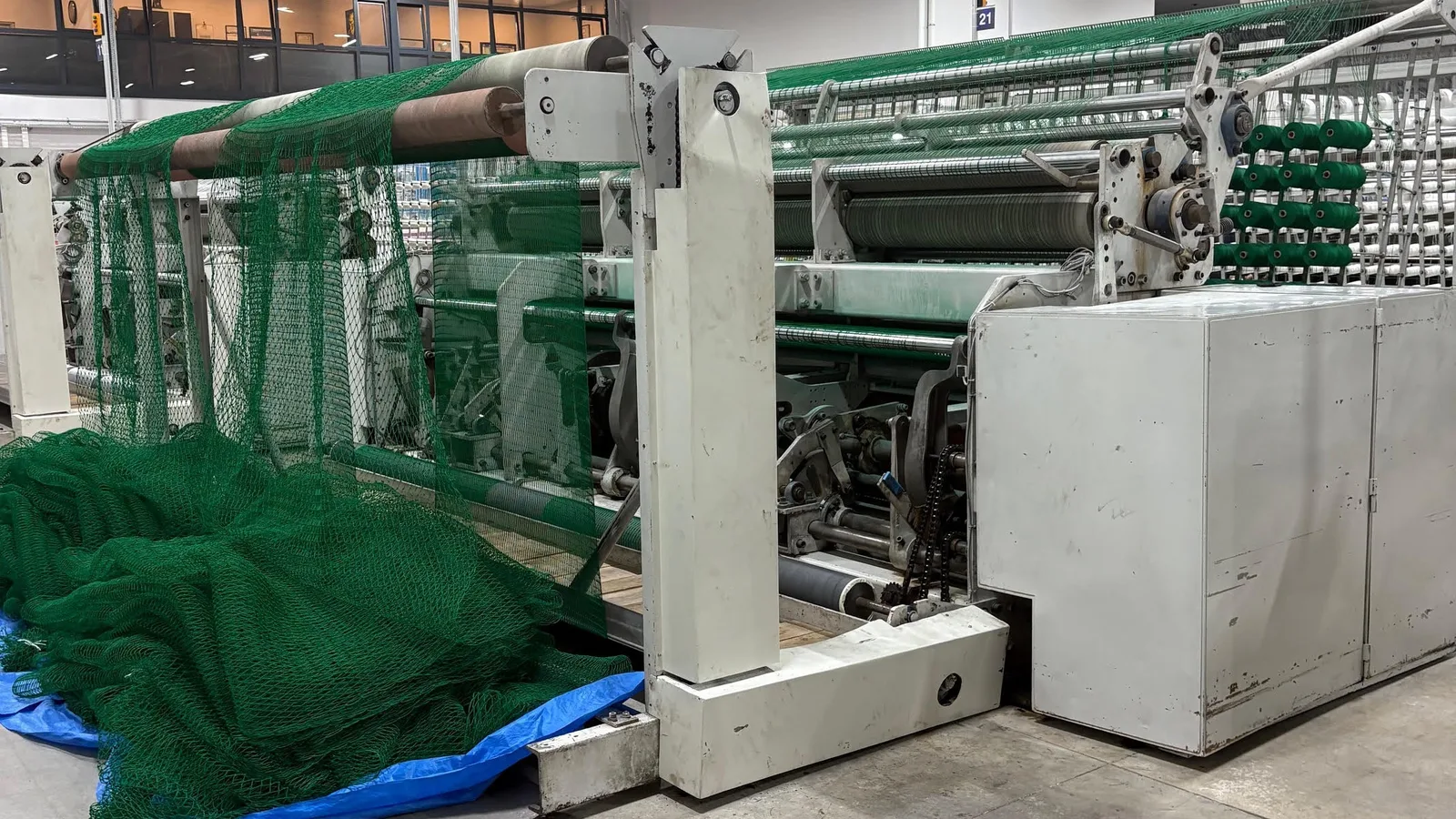
Heavy-thread loom at the Tunanets plant in Yozgat, with a panel of green knotted netting.
We give no figures for durability in the sun. There is no published UV test for these references, and the 3 to 5 year service lives in many product sheets do not cite one either. Ask for the procedure: xenon-arc ageing (ISO 4892-2:2013) and, before and after it, mesh breaking force (ISO 1806:2002) and twine and knot breaking force (ISO 1805:2006). Retained strength is what lets you compare suppliers.
Can a fishing net be used to harvest olives? No: an olive harvesting net is a different product
Product sheets for olive harvesting nets sold in Spain describe polyethylene or polypropylene monofilament, thorn-resistant and with reinforced edges. They are sold as squares with an opening for the trunk (8 × 8 to 12 × 12 m) or as rectangular pairs (4 × 8 to 6 × 12 m).
The olive net works on the ground: workers walk on it, drag it with the olives on top and fold it every day. It needs a light, dense surface, not a tensioned mesh. It has its own standard, the Italian UNI 10407:1995, on polyethylene fibre nets for olive harvesting. We have not found an equivalent EN or UNE standard. If you buy olive harvesting nets, ask for the sheet with material, weight per square metre and, if the supplier declares it, conformity with UNI 10407.
How do you order a custom net panel? With seven data points in writing
ISO 1530:2003 sets how to describe and designate knotted netting. The factory will decide anything that is not in the order, using its own standard. The diagram shows the seven data points.
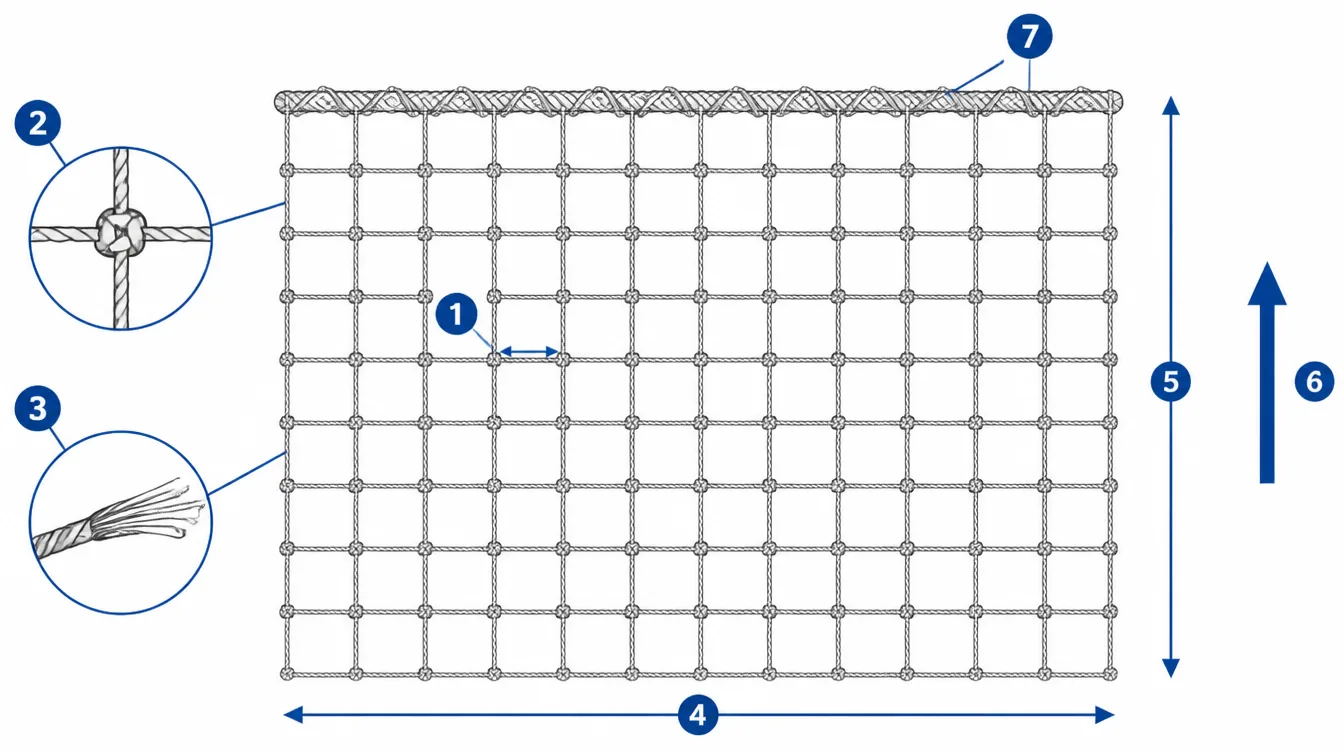
- Mesh size: side of one square, knot to knot.
- Knot.
- Twine (ply count).
- Panel length.
- Panel depth (height).
- Stretch direction.
- Border rope.
- Stretch direction. This is the direction in which the factory stretches and sets the panel, and it decides how the meshes are oriented. According to the Tunanets dossier, nets are stretched lengthwise in Turkey and depthwise in Europe. Tunanets can stretch them depthwise at extra cost. If you do not specify it, expect the Turkish standard.
- Panel depth. Give it in metres or in number of meshes, and say which one.
- Border rope. This is the rope that reinforces the edge and holds the net to the cable. Ask if it comes fitted from the factory. If the net arrives cut to size with the border rope fitted, it may count as a made-up net and fall under heading 5608. That is another reason to request Binding Tariff Information (BTI).
The usual lead time is 3 to 4 weeks: 2 to 3 weeks of manufacturing in Yozgat and 5 to 7 days by road (AHCEBRIAN operating lead times with Tunanets).
You can ask AHCEBRIAN for the Tunanets HDPE and polyamide sheets and a sample panel with the mesh you have chosen. With the sample, you can check the mesh size, the knot and the stretch before you order.
Which rules apply to an agricultural net? Birds, end of life and customs
In all three areas, we give our reading, not an official interpretation. For birds and end of life, we use Spain and Portugal as examples; check the equivalent rules in your country.
Protected birds: the net must exclude birds, not capture them
The Birds Directive 2009/147/EC applies in every EU Member State. Its Article 8 and Annex IV, on the hunting, capture or killing of birds, list “nets” among the means that Member States must prohibit. In Spain, for example, Law 42/2007 on Natural Heritage and Biodiversity (Spanish law) prohibits “intentionally killing, harming, disturbing or upsetting wild animals”, nests included (Art. 54.5, our translation). Its Art. 65.3.a and Annex VII, on prohibited means of capture in hunting, also cite “nets”.
Our reading: an exclusion net is not a means of capture. However, a net that is slack, forms pockets or is open at the bottom can entangle protected birds. We recommend tensioning it, closing the bottom edges, checking it often and making sure there are no occupied nests before you cover. If in doubt, ask your regional or national environmental authority.
End of life: producer responsibility is planned but not yet regulated
In Spain, Law 7/2022 on waste (Spanish law) required a regulation on extended producer responsibility (EPR) for “non-packaging agricultural plastics” (seventh final provision). It set a deadline of three years, until April 2025. As of September 2026, that regulation does not exist. The Spanish waste plan PEMAR 2025-2035 (Resolution of 22 December 2025) keeps it as a goal. In our view, an HDPE or polyamide agricultural net would fall within it, and the law also treats the importer as a producer (Art. 2.ac). In Portugal, the environment agency (APA) and the agriculture planning office (GPP) began a study in May 2026 on the recycling of agricultural plastics, nets included, which had scheduled its final report for September 2026.
Customs: indicative CN code and A.TR
Tunanets nets are industrial products. Within the EU-Turkey customs union, they travel under an A.TR movement certificate. The code depends on the thickness of the twine. What follows is our calculation based on the Combined Nomenclature 2026, not an official classification.
Heading 5608 covers “knotted netting of twine, cordage or rope”. Note 3 to Section XI treats man-made fibre yarn of more than 10,000 decitex (dtex) as twine. Below that, a knotted net is a net fabric of subheading 5804 10 (“tulles and other net fabrics”). Raschel netting in the piece is a warp knit fabric and falls under 6005.
With 1 denier = 1.111 dtex, 24 ply of HDPE add up to 9,120 denier, about 10,130 dtex. From 24 ply (24, 27, 36 and 42), HDPE points to 5608. From 9 to 21 ply (up to about 8,870 dtex), it points to 5804 10. In 210 denier polyamide, up to 42 ply (about 9,800 dtex) points to 5804 10, and 54 ply or more points to 5608. These are nominal counts: twisting increases the real count. If the code matters, request BTI before the first order.
What to do now
- Decide the use with the first table: for hail netting or olive harvesting nets, we do not recommend knotted netting.
- Set the mesh size by the bird that causes the damage, and write down how it is measured.
- Choose material and colour together: in HDPE, the ply count decides the colour; in polyamide, ask for the Pantone reference.
- Ask each supplier for three things: the designation according to ISO 1530, the ISO 1806 and ISO 1805 breaking-force tests, and ISO 4892-2 ageing with the retained strength.
- Confirm in writing the stretch direction, the depth, the border rope, the weight per square metre, the proposed CN code and the A.TR certificate.