Ballistic plate and helmet materials: what each one means when you buy them
Ceramic breaks up the projectile tip and needs a fibre backing; UHMWPE has about a quarter of the density of alumina and is sensitive to heat. What each material means in use and storage, and why the specification should ask for level, standard and type.
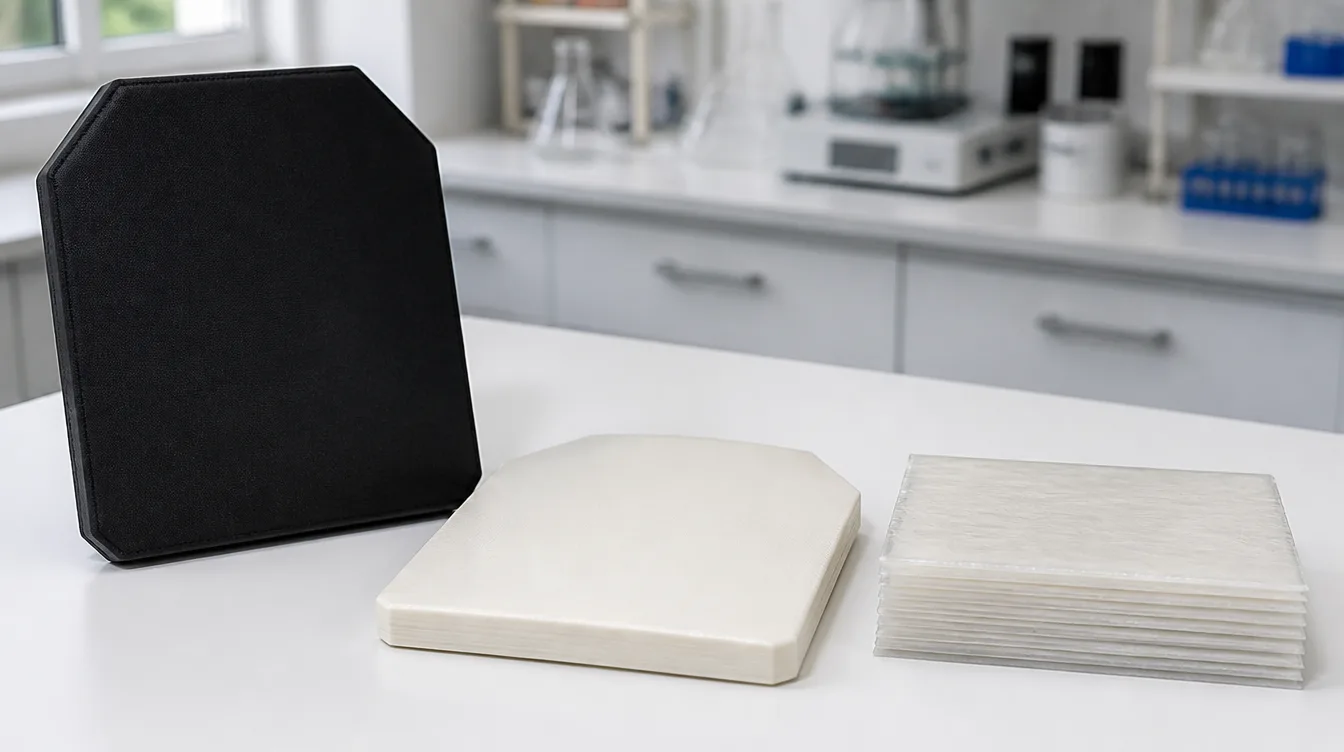
Among ballistic plate materials, ceramic breaks up the tip of the projectile on a fibre backing. Ultra-high-molecular-weight polyethylene (UHMWPE) has about a quarter of the density of alumina ceramic and tolerates heat less well. There are also aramid plates. Composite helmets are made of glass fibre, UHMWPE or aramid, never of ceramic. The tender specification should ask for level, standard and plate type (stand-alone or ICW), and name the material only with a reason.
In short
- The material is a consequence, not the requirement: level, standard and plate type define what you buy. Set the material only when there is a reason, and always with “or equivalent”.
- Each material comes with its own conditions of use: ceramic needs inspection after knocks and drops. UHMWPE must be stored away from heat, because it melts at around 130 °C and ages under sustained high temperatures.
- An ICW plate is bought with its vest: NIJ 0101.07 recognises its level only when it is paired with a specific model of soft armour.
What are ballistic plates made of?
A ballistic plate is a rigid insert that goes into the vest or the plate carrier to protect the torso. The US standard NIJ 0101.07 (2023) calls it “hard armor”. It is made of ceramic on a fibre backing, of pressed polyethylene or of aramid. The ballistic plates from Garanti Kompozit, a manufacturer based in Türkiye that AHCEBRIAN represents commercially, are ceramic with a backing or pressed polyethylene.
- Ceramic with a backing. A strike face of alumina, silicon carbide (SiC) or boron carbide (B4C), bonded to a fibre backing. According to Chen et al. (Materials, 2022), the ceramic destroys the tip of the projectile, slows it down and spreads the load over the backing. The backing holds the broken ceramic together and slows the projectile as it deforms.
- Pressed polyethylene. Layers of UHMWPE UD fabric crossed at 0° and 90°, impregnated with resin and hot-pressed. In the Chen study, the laminate has a density of 0.97 g/cm³. There is no hard face: the laminate absorbs energy as it deforms.
- Aramid. A synthetic fibre used as a fabric or in a composite (Kevlar is a trade name). Alkhatib et al. (Polymers, 2021) test plates made entirely of aramid composite. Chen et al. (Scientific Reports, 2024) list it, as a composite, among backing materials, at 1.4 g/cm³. In the Garanti Kompozit range, aramid appears in helmets, not in plates.
Attribute | Alumina | Silicon carbide | Boron carbide | Pressed UHMWPE | Aramid composite |
|---|---|---|---|---|---|
Density (g/cm³) | 3.78-3.91, depending on purity | 3.0-3.2 | 2.46-2.52 | 0.97 | 1.4 |
Role | Strike face | Strike face | Strike face | Backing, complete plate or helmet | Plate, backing or helmet |
What sets it apart | The densest and the cheapest of the three ceramics | Middle ground in hardness, density and cost | The hardest and lightest, and the most expensive | The least dense material in the table | Density between UHMWPE and ceramic |
What to watch | Brittleness: inspect after knocks and drops | Brittleness: inspect after knocks and drops | Brittleness: inspect after knocks and drops | Heat: melts at around 130 °C and ages sooner | Weight: denser than UHMWPE |
Source | Chen et al., 2022 and 2024; Liang et al., 2021 | Chen et al., 2024; Alkhatib et al., 2021; Liang et al., 2021 |
The comparison of hardness and cost between the ceramics comes from Chen et al. (2024). The density of the material is not the density of the plate: the mass of a plate depends on the backing, the cover and the thickness that the level requires. Use the table to understand relative thickness and weight, not to choose a level.
What is UD fabric, and why is it in vests, plates and helmets?
UD (unidirectional) fabric is a sheet in which all the fibres run parallel, with no weft. Each sheet works in one direction only. That is why the sheets are stacked crossed at 0° and 90° and bonded with resin, heat and pressure (Yi et al., Polymers, 2024, with a polyurethane matrix).
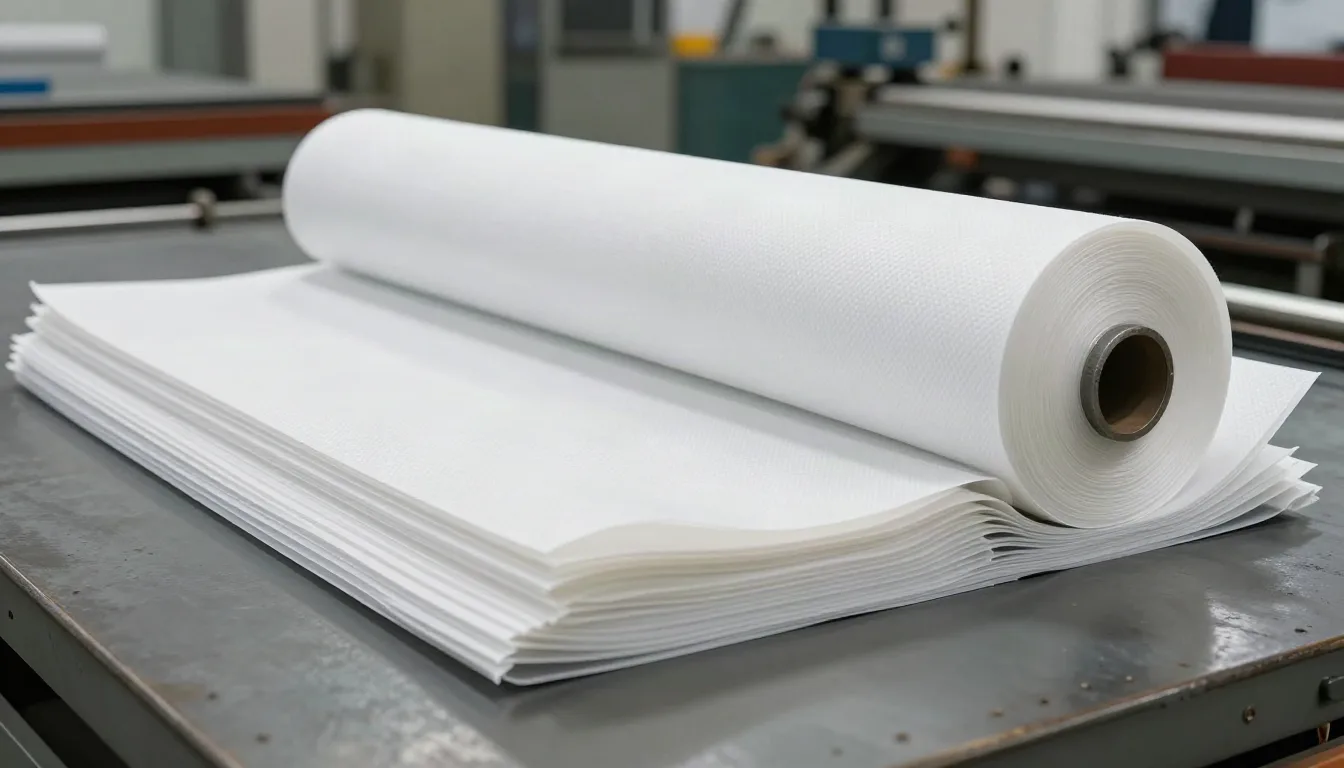
Garanti Kompozit produces its own UD polyethylene fabric in an integrated plant in Yozgat. According to its 2026 catalogue, the fabric comes in weights from 110 to 160 g/m², in grades for soft and hard armour. It is the common raw material of its vests, plates, shields and helmets, and of its vehicle and aircraft armour. The fabric is tested in the company’s own ballistic laboratory. It is made for the manufacturer’s own products. If a project needs UD fabric, availability is discussed case by case, subject to the applicable authorisations.
For a plate buyer, this answers a question in the procurement file: who produces the fibre, and where. The materials data sheet in the UK Home Office Body Armour Standard (2017) asks for this information, producer and location, for each pressed fibre element. It also asks for the yarn tex (grams per 1,000 m), the number of layers and the adhesives. A manufacturer that makes its own UD fabric can declare these data first-hand.
Ceramic vs UHMWPE plate: what changes in use and storage?
Three things change: the thickness, what must be checked after a knock, and the temperature the plate can take in storage.
Thickness
For the same mass per unit area, the less dense material takes up more thickness. UHMWPE has about a quarter of the density of alumina and about 40 % of that of boron carbide. That is why an all-polyethylene plate is usually thicker. How much mass each construction needs for a given level is stated only in the test report for that model.
Knocks, drops and inspection
Ceramic is hard and brittle, and not all of its damage is visible. Chen et al. (2022) list several types of damage in ceramic plates with a backing: cracking of the ceramic, delamination between layers and invisible damage such as microcracks. NIJ 0101.07 requires plates to arrive for testing without cracks, chips or variations in thickness. It also subjects them to impact durability conditioning (ASTM E3078/E3078M-23).
The Home Office guidance 039/17 recommends inspecting body armour at intervals of no more than 12 months and checking it after any impact. After a ballistic or stab impact, the armour must always be replaced. For ceramic plates, we recommend asking the manufacturer, before you award the contract, how a plate is checked after a drop and what criterion is used to withdraw it from service.
Temperature
UHMWPE is a thermoplastic: the table in Chen et al. (2024) gives its melting point as 130 °C. Heat ages it long before it melts. A NIST study (Tsinas et al., Polymers, 2022) aged UHMWPE fibres between 43 and 115 °C and observed chain scission (breakage of the polymer chains), which was more pronounced at higher temperatures. In UD laminates, Yi et al. (2024) found that yield strength and stiffness (modulus) fall as the temperature rises between −20 and 80 °C.
The 2017 Home Office standard includes an optional test that preconditions panels for 24 hours at +50 °C or at −20 °C. The test simulates armour that was stored in those conditions before use. If the armour passes, the certificate and the label say so. Guidance 039/17 asks for storage away from direct sunlight, heat sources and excessive humidity.
Our position: if the plates will spend time in vehicles, guard posts or warehouses without climate control, do not ask for “ceramic” or “polyethylene”. Ask for a test after conditioning at the expected temperature.
Stand-alone or ICW plate: why does it matter more than the material?
Because it decides what you buy: a single plate, or a system of plate and vest. NIJ 0101.07 distinguishes “soft armor”, “stand-alone hard armor” and “ICW (in conjunction with) hard armor”. An ICW plate gives its declared level only when it is paired with a specific model of soft armour. To certify the plate, that vest must be on the 0101.07 Compliant Products List (sections 1.3 and 10.1). The Home Office standard also assesses plates on their own or in combination with a certified soft panel.
In practice, a stand-alone plate can go into another plate carrier. An ICW plate bought without its vest, or placed in a different vest, is no longer covered by its test report. Two plates of the same material may therefore need different purchases.
An example from a real range: the GRPB plates from Garanti Kompozit are ceramic or UHMWPE, stand-alone or ICW. The ICW plates are designed for use with the manufacturer’s own soft vest. They come in ergonomic or lightweight versions, with single, double or multiple curvature. Each batch is checked against the quality plan before it leaves the plant. The level of each model is provided on request.
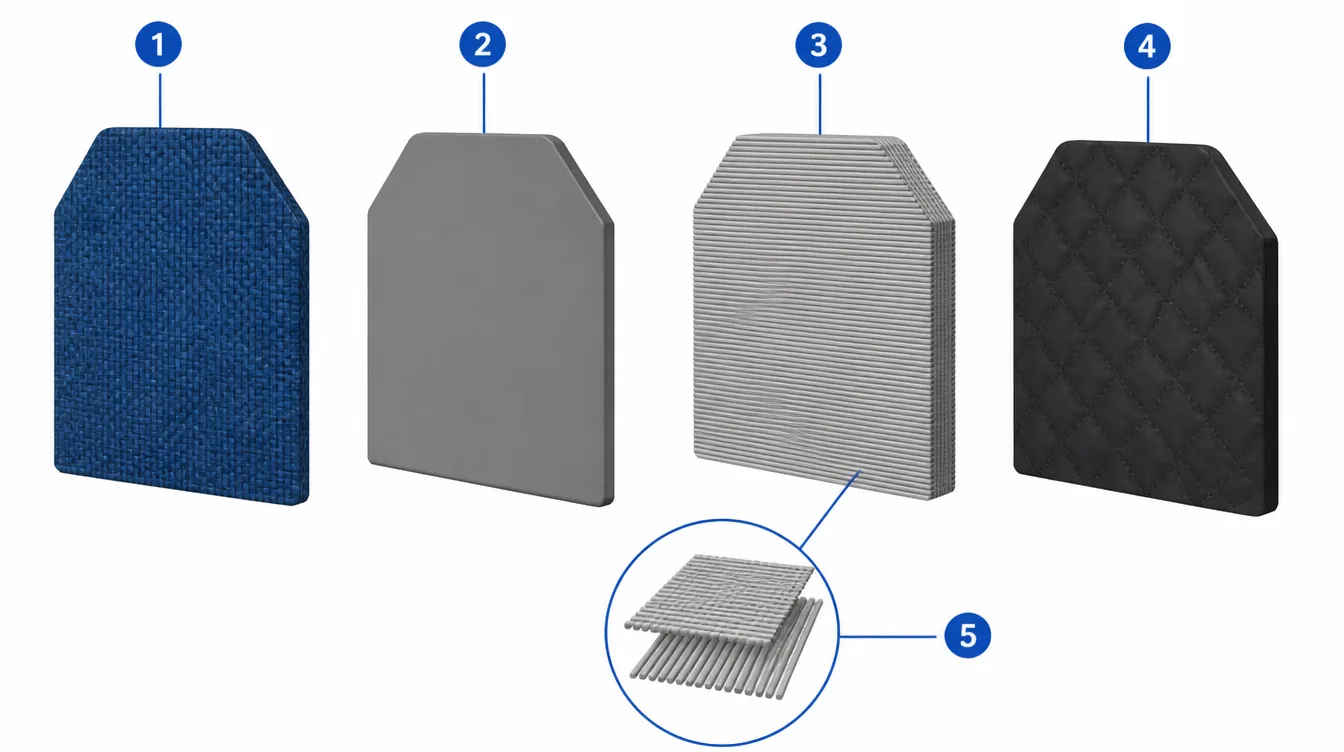
- Outer cover.
- Ceramic strike face.
- Backing of pressed UD layers.
- Soft vest panel behind the plate (ICW case).
- Detail of the backing: sheets of straight, parallel fibres, not woven, crossed at 0° and 90°.
Curvature also matters. NIJ 0101.07 requires one shot at the crown of curved plates. The crown is the highest point of the strike face, where the curves meet. The supplier must provide a dimensioned diagram that shows its position. NIJ explains that, at this point, the materials or the manufacturing method may make the plate more vulnerable.
What are ballistic helmets made of, and when should you set the material?
A composite ballistic helmet is made of glass fibre, UHMWPE or aramid, alone or combined; helmets do not use ceramic. Unless there is a specific reason, the specification should not set the material. The review by Liang et al. (Applied Composite Materials, 2021) groups current ballistic helmets by material into three types: UHMWPE, aramid and hybrid, which combine both fibres or others. The NIST study cited above notes that many soft armour panels, plates and helmets rely on UHMWPE fibre. The temperature precautions therefore also apply to a polyethylene helmet.
Garanti Kompozit makes PASGT, MICH, ACH and ECH helmets in UHMWPE, aramid or hybrid construction. Its ACH range shows how a manufacturer can answer a tender specification that sets the material. The standard ACH has a UHMWPE shell. The aramid ACH keeps the same geometry and the same accessories, for specifications that call for that material. The GG-BRH rifle-resistant helmet, from the same family, is made of UHMWPE. Levels, weights and reports can be requested from the page on Garanti Kompozit ballistic helmets.
If your specification sets aramid, it helps to know why. Some reasons are defensible: a temperature requirement that the UHMWPE helmets on offer cannot demonstrate in a test, or continuity with helmets and accessories already in service. If the only reason is habit, setting the material reduces competition and does not improve the specification.
How should the material be written into a tender specification?
Ask for performance and documentation, and set the material only when a reason justifies it. This is our position, as the commercial representative of a manufacturer that offers ceramic and polyethylene plates:
- Level and standard. The required level, and the standard with its edition and addenda, always with “or equivalent”.
- Plate type. Stand-alone, or ICW with the model of soft vest it was certified with. In that case, the vest becomes part of the supply.
- Materials data sheet. The data in Appendix B of the Home Office 2017 standard for each ceramic or pressed fibre element.
- Conditions of use. Storage temperature, maximum weight per plate, curvature and sizes.
- Material, only with a reason. The reason should appear in the specification, and a test should be able to verify the requirement.
Two example clauses:
“Stand-alone rigid plate at level (required level) according to (standard, edition and addenda) or equivalent, supported by a test report from a laboratory accredited to ISO/IEC 17025, current edition, or equivalent. Tenderers shall provide a materials data sheet: type, thickness, density and Vickers hardness of each ceramic element; number of layers, adhesives and producer of each pressed fibre element.”
“The plates shall maintain the required level after preconditioning for 24 hours at +50 °C, in accordance with section 9.2.2 of the Home Office Body Armour Standard (2017), or an equivalent test.”
The second clause asks for performance under heat instead of a material. It lets any material compete, and it requires proof. One last note: for export control purposes, each plate, helmet or fabric is classified product by product with the competent authority.
What to ask the manufacturer before awarding the contract
- What level, standard and edition does each model have? Ask for the test report and, if the standard is NIJ, the model’s status on the Compliant Products List.
- Is the plate stand-alone or ICW? If it is ICW, ask for the exact vest model, and whether that vest is included in the offer.
- Do you provide the materials data sheet? It should give the producer and location of the ceramic and of the fibre.
- Between which temperatures can the plate be stored and used? And which test supports this?
- How is the plate inspected in service? Ask for the interval, the method after a drop, the withdrawal criterion and the batch control.
If you are preparing a tender specification or comparing bids, you can ask AHCEBRIAN for the technical data sheet of the Garanti Kompozit vests and plates. Tell us which organisation or company you represent, the intended use and the quantities. We send you levels, test standards and reports once the transaction has been identified and the authorisations it requires have been checked.