What is anti-drone netting? How passive nets stop a drone and what they cannot do
Anti-drone netting is a passive barrier of knotted polyamide that stops a drone by tangling its propellers. It emits nothing and needs no power. It protects only what it covers: it complements detection and countermeasures, it does not replace them.
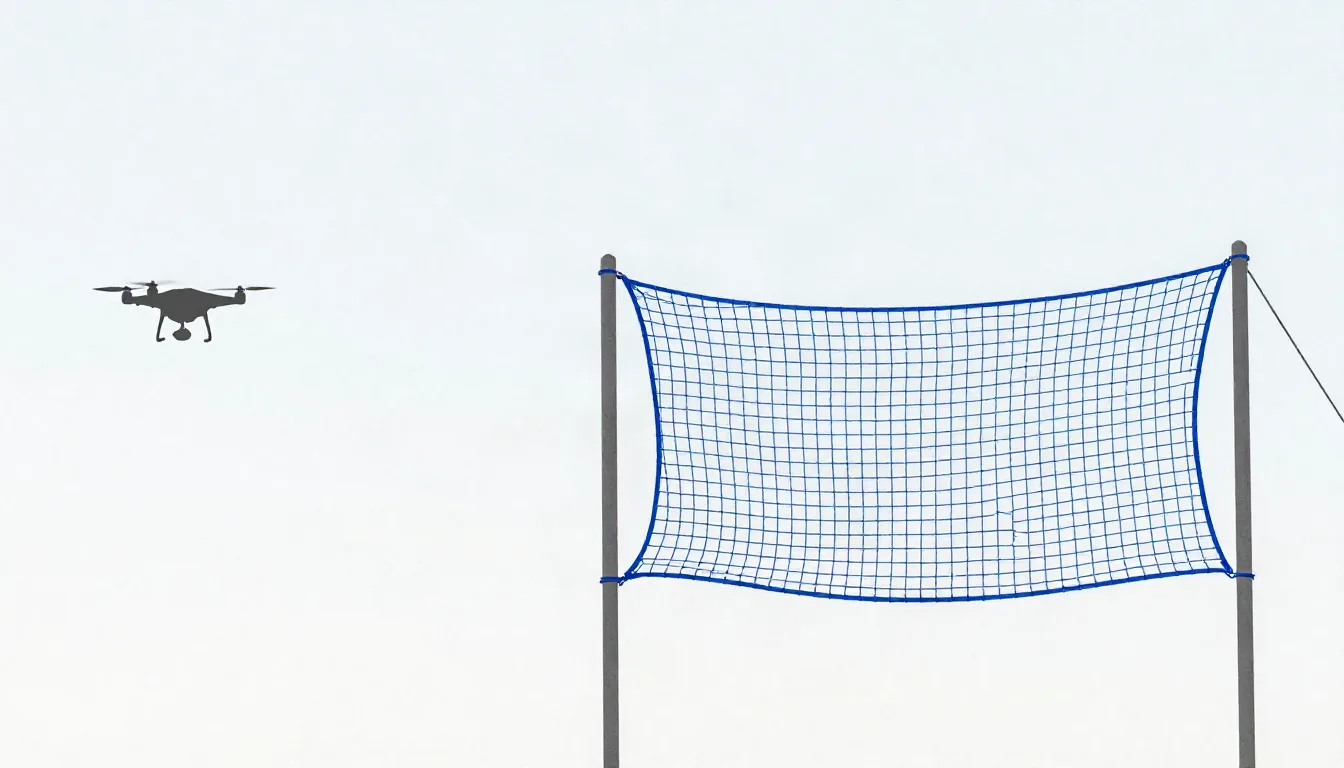
Anti-drone netting is a passive physical barrier made of textile fibre, usually knotted polyamide. It stops a small drone by tangling its propellers, and it emits no signal. It needs no detection, no power and no spectrum licence. It protects what it covers 24 hours a day, but only what it covers. For this reason it is used as a physical layer that complements detection and jamming rather than replacing them.
In short
- What it is: a net panel strung over posts, cables or a structure. It blocks the path of a drone above or at the sides of an asset.
- How it differs: a net launcher and a jammer act against a drone that has already been detected. A fixed net acts on its own, with no operator, but only on the area it covers.
- What to ask for: the full reference (twine, mesh size and depth), the panel length, the colour and the lead time.
What is a passive anti-drone net?
A passive anti-drone net is a fixed net panel with no electronics. It stands between the drone and the asset you want to protect. "Passive" means that it does not emit, detect or decide. It is always in place, and it acts only when an aircraft flies into it.
The Tunanets anti-drone nets distributed by AHCEBRIAN S.L. are made of knotted N6 polyamide (Nylon 6). The twine is 210 denier, made of 6 to 21 plies. Denier is the linear density of each ply: the weight in grams of 9,000 m of yarn. The factory catalogue has 17 references in production, with mesh sizes from 20 to 300 mm and depths from 26 to 100 meshes. All references are supplied in panels of 200 m stretched length, in white, khaki or tan depending on the season.
Tunanets manufactures in Yozgat, Türkiye. The company has more than four years of continuous supply to active conflict zones in Eastern Europe. AHCEBRIAN distributes the range in Europe and sizes each order with the customer.
What do anti-drone nets do, and how do they stop a drone?
The net stops the drone by mechanical means. When the aircraft hits the panel, the mesh absorbs the impact energy and tangles the propellers and the landing gear. A multirotor that cannot turn its propellers loses lift. The aircraft then falls, held in the net or outside the protected area.
The net does not act on any signal, so the type of guidance makes no difference. A drone guided by fibre optic cable does not use a radio link, so a jammer has no effect on it. Autonomous navigation does not need a link to the pilot, although it may depend on GNSS (satellite positioning), which can be jammed. A physical barrier depends on none of these signals.
The mesh size is chosen by the size of the aircraft. The Tunanets catalogue groups its references into three indicative ranges:
- Fine mesh, 20 to 45 mm: small FPV-type aircraft (first-person-view drones). This is the tightest mesh in the catalogue.
- Medium mesh, 70 to 100 mm: larger multirotors and light fixed-wing aircraft.
- Wide mesh, 150 to 300 mm: large areas and outer layers, with less weight and less wind load on the structure.
These ranges are a starting point, not a guarantee. An article from the Modern War Institute at West Point (W. Mayne, 29 April 2026) notes that there is still no standard guidance on which net suits each drone group.
Fixed net, net launcher and jammer: what is the difference?
These three countermeasures are often named together because two of them use a net. But they work in opposite ways. A net launcher fires a net at one specific drone that someone has detected and aimed at. A jammer emits radio frequency to cut the link between the drone and its pilot. A fixed net does nothing until the aircraft reaches it.
Attribute | Passive fixed net | Net launcher | Jammer |
|---|---|---|---|
When it acts | At all times, when the drone enters the panel | When an operator fires at a specific drone | While it is emitting |
Needs prior detection | No | Yes | Yes, or continuous emission |
Needs an operator or power | No | Operator | Power and, in general, an operator |
What it covers | Only the area where the net is strung | One aircraft at a time | Drones that depend on a radio link |
Permits | No spectrum permit; any building or installation permits that apply | Depends on the device and the country | Subject to the legal spectrum rules of each country |
Weak point | No protection outside the area it covers | Depends on detecting and aiming in time | No effect on fibre optic guidance; against autonomous navigation, only if it jams GNSS |
The table does not rank the three from best to worst. Each one covers a different gap, which is why passive counter-drone measures are combined with active ones. The US Department of Defense JIATF-401 guide (see below) and the Modern War Institute article both present them in combination.
Where is it installed: canopy, curtain or cage?
An anti-drone net is installed in one of three configurations. The choice depends on the directions from which a drone can arrive:
- Overhead canopy: a horizontal panel above the asset. It covers vertical and diving approaches, which a perimeter wall does not stop.
- Vertical curtain: panels on posts that close low-level approaches from one side.
- Cage: canopy and curtains joined together. They close the full volume around a piece of equipment or a building.
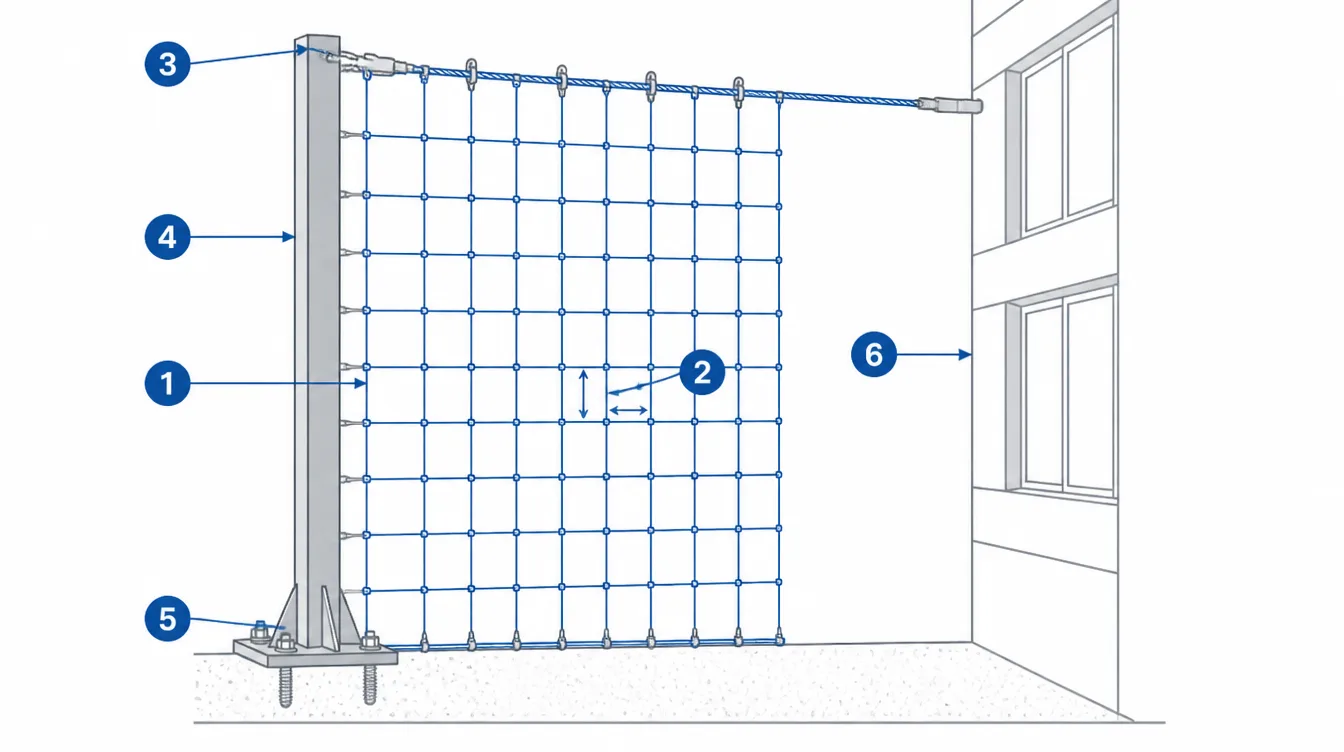
- Knotted polyamide net
- Mesh size
- Perimeter cable
- Steel post
- Ground anchor
- Facade of the protected building or asset
The usual assembly is on posts or a light structure with a tensioning cable. Panels overlap and are laced together, so a damaged section can be replaced without taking down the rest. AHCEBRIAN does not supply installation. It delivers the panel and the technical support to size it.
The JIATF-401 Guide for Physical Protection of Critical Infrastructure comes from the US Department of Defense (30 January 2026). It organises protection around three lines: harden, obscure and perimeter. Hardening includes overhead netting or tensioned cables above entrances. According to the guide, these physical measures complement specialised counter-drone systems rather than replace them.
What can an anti-drone net not do?
An anti-drone net does not protect anything outside the panel. If one side is left open, or the canopy does not reach the edge, a drone can enter there. For this reason the design starts with the directions of approach, not with the number of square metres.
Also, not every mesh works against every aircraft. A mesh that is too open lets a small drone through. A mesh that is too tight adds weight and wind load, and the structure has to carry that load. The installation design sets that load, not the net.
The net does not detect or identify anything either. Outdoors, the panel ages over time. Plan for regular inspections and replacement section by section, and ask the manufacturer for the strength data of the reference you choose.
Our position: we do not recommend a net as the only measure. It is a physical layer that complements detection and electronic countermeasures. It does not replace them.
For context on the European framework: the European Commission Action Plan on Drone and Counter Drone Security (COM(2026) 81, 11 February 2026) planned non-binding guidelines for critical entities, with specific guidance on drone threats. The Commission adopted them on 10 July 2026. The plan also foresees a recommendation on voluntary performance requirements for counter-drone systems, by the fourth quarter of 2026.
What data should you ask the manufacturer for?
Always ask for the full reference, because it gives three key specifications in one code. In the Tunanets naming system, 9-70-64 means 210/9 twine (9 plies of 210 denier), 70 mm mesh and 64 meshes deep. The indicative drop of the stretched panel is mesh size times number of meshes: 70 mm × 64 = 4.48 m. The real value depends on tension and hardware.
With the reference in hand, complete your request with these details:
- Material and construction: knotted N6 polyamide across the whole current range. At customer request, Tunanets is working on an HMPE line (high-modulus polyethylene), with no date yet.
- Mesh size: chosen by the size of the aircraft. The twine thickness is chosen by the load and the expected service life.
- Panel length: 200 m stretched for every reference. This sets how many panels and seams the installation needs.
- Colour: white, khaki or tan, depending on the season.
- Lead time: 3 to 4 weeks in total. This is 2 to 3 weeks of manufacturing in Yozgat plus 5 to 7 days by truck to the Iberian Peninsula, with weekly departures.
Describe your site to us (area, available structure and type of aircraft). We will propose a reference and mesh size and send you the technical datasheet. You can see all 17 references in the anti-drone net technical catalogue.
What to do next
- Draw the directions from which an aircraft can reach your asset: from above, from the side or both. This decides between canopy, curtain or cage.
- Measure the area to cover and note which existing structure can hold posts and cables.
- Define the size of the aircraft you are concerned about, to choose between fine, medium or wide mesh.
- Check which detection and countermeasures you already have, so that the net closes a specific gap and does not duplicate another layer.
- Ask the manufacturer for the full reference, panel length, colour and lead time, and compare offers on those same data.